
We exist to explore ways in which we can rewire our singular and shared creative confidence. We desperately need more people to be thinking deeply and imaginatively about the challenges that currently face the world. Our vision is to spark much imagination, creativity, and innovative thought as possible.
Our mission is to help individuals and organisations to strengthen and light their creative abilities to unlock original, disruptive ideas and innovation. We strive to bring tools and methods that helps with the flow of new thinking and new ways to grow - both as individuals and businesses.
Throughout our journey, we've curated countless workshops catered to diverse businesses and organizations. Each session is crafted to align with the specific requirements of our clients.
In many companies, creativity is expected but rarely supported by clear structures or processes. Teams are frequently under pressure to deliver innovative solutions quickly, yet the environments in which ideas are developed are often unclear, unstructured, or shaped by hierarchical dynamics that limit participation.
We have investigated how better environments for creative thinking could be designed. Drawing on theories from design thinking, innovation management, and cognitive framing, this quest explored how people can break out of fixed patterns of thinking and approach problems from new perspectives.
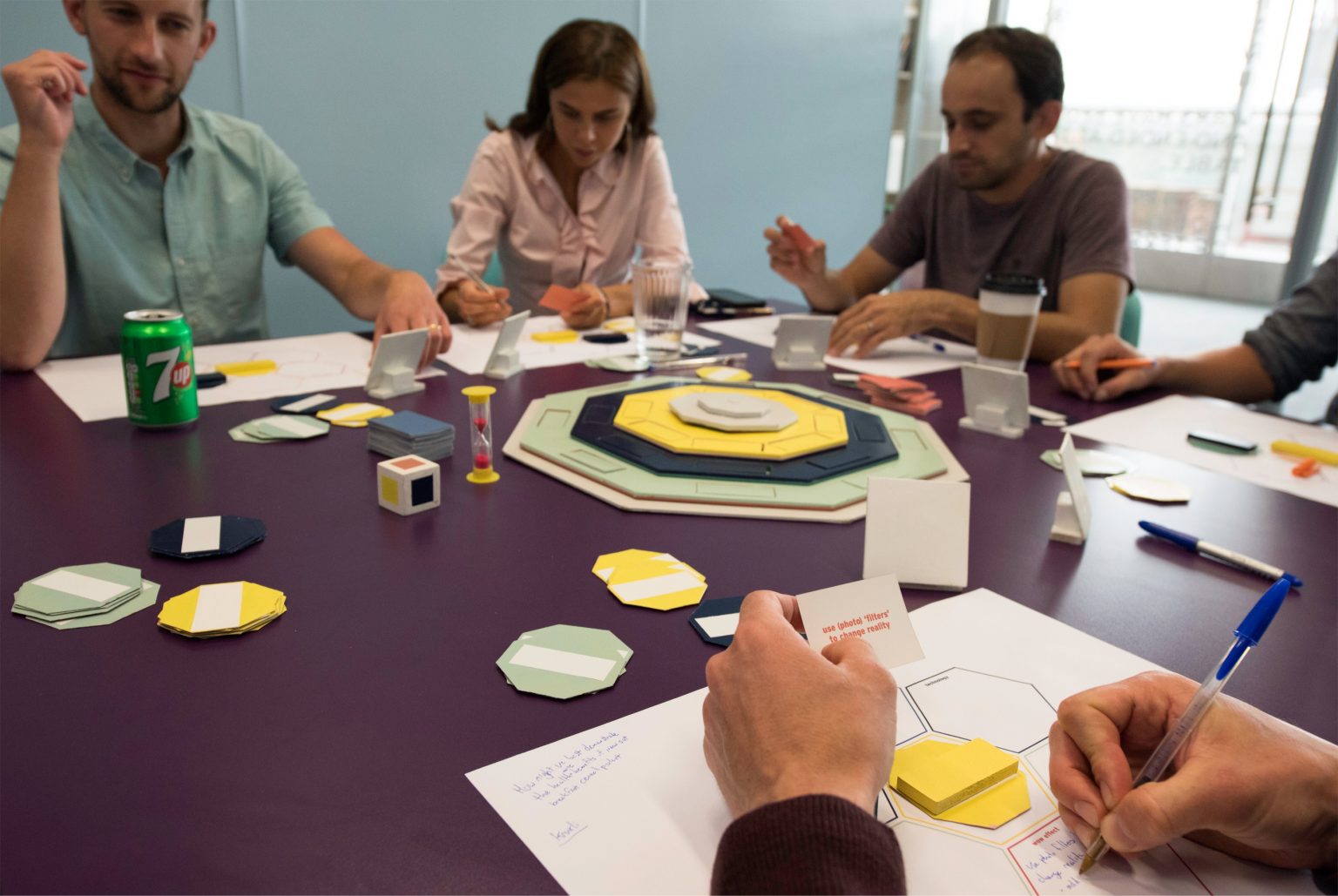
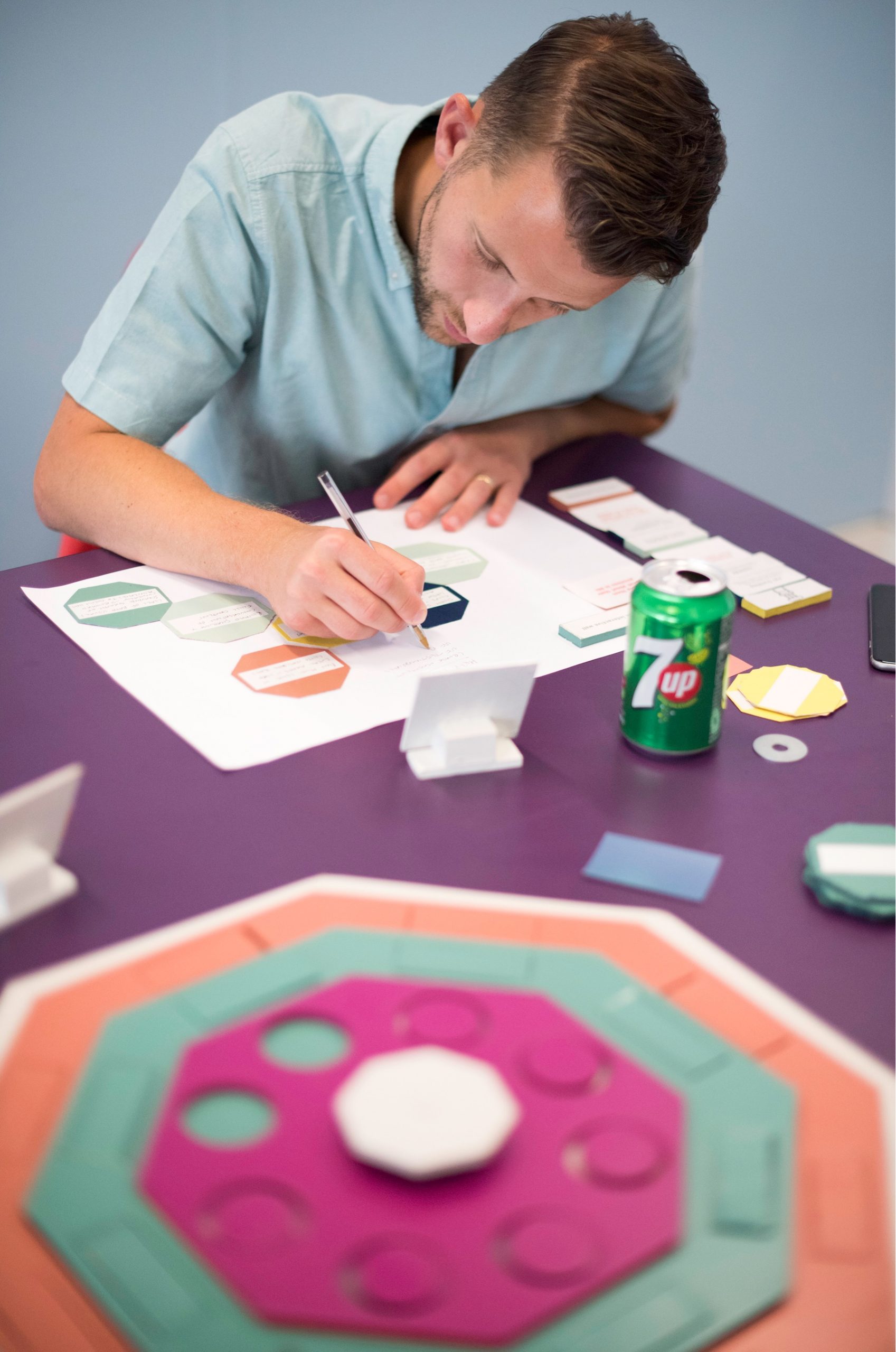
This exploration led to the development of the first prototype of an organisational ideation game. The prototype was handcrafted in wood and featured a spinning wheel that guided players through different categories and prompts. These prompts introduced metaphors and perspectives designed to help participants reframe a problem and build new narratives around potential solutions.
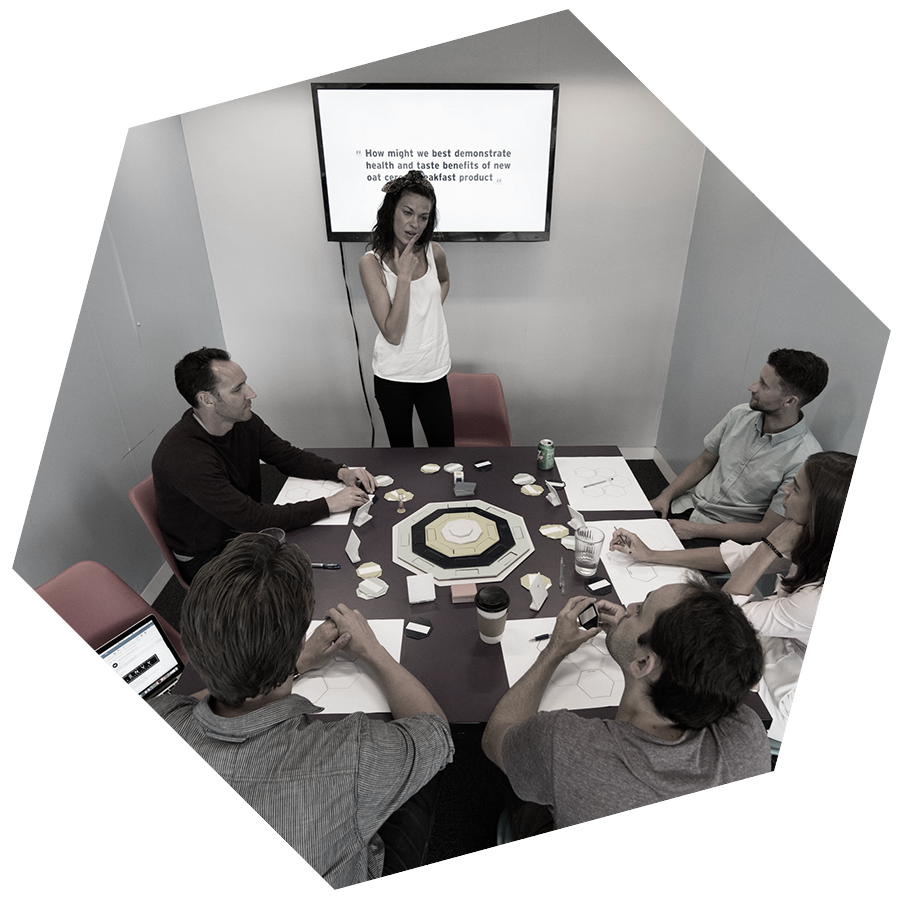
The concept was tested with teams at the creative agency AMV BBDO in London. During the sessions, participants quickly engaged with the format and began contributing ideas openly. The playful structure created a space where people across different roles felt comfortable sharing thoughts, experimenting, and building on each other’s ideas.
These early experiments became the foundation for the next stage of development. What started as a research prototype gradually evolved into a more refined game concept designed to facilitate collaborative ideation and help teams unlock new ways of thinking.
Some myths persist in the belief that creativity results from a complete lack of boundaries and total freedom. In reality, however, we are not capable of operating without boundaries; rather, we depend on them to focus our creative energy into meaningful channels.
Play allows us to transcend mere reflexes and move toward creativity and meaning. It features a distinctive combination of repetition and variation that stimulates the imagination and captures attention. Play is made possible by the presence of play objects and by the absence of perceived threats, relative to the individual’s dispositions.
However, “play” is not simply the name of an act or an action. Instead, it constitutes a frame that is deeply woven into our cultural and social life. One might recall having said, “This is not fun — I thought you said this was a game?” This illustrates how social groups collectively recognize and negotiate the boundaries of the gaming frame.
Social games create spaces and practices for creative expression, social interaction, and identity co-creation. They also function as mechanisms through which relationships are enacted and sustained, both within and beyond the game environment.
Games are particularly useful for sharing and transferring knowledge across boundaries. They cultivate a specific mindsetthat enables participants to explore new perspectives and frames of understanding.
Some myths persist on the understanding that creativity results from a complete lack of boundaries and total freedom, but the reality is that we are not capable of operating without boundaries; we need them to focus our creative energy into the right channels.
Play affords the transcendence of mere reflexes towards creativity and meaning, and it features a peculiar combination of repetition and variation; that stimulates the imagination and captivates attention. It is afforded by the presence of play objects and the absence of perceived threats relative to the individual’s dispositions.
However, “play” is not the name of the act, nor the action, rather it constitutes a frame which is deeply woven into our cultural and social life. One might recall having said: “This is not fun – I thought you said this was a game?” This is a good example of how some social groups all share the same perspective on the gaming frame.
Social games enable spaces for and practices of creative expression, social dynamics and identity co-creation. They also form a mechanism through which relations can be enacted and maintained across and outside of the game environment.
Games are particularly a useful for sharing and transferring knowledge across boundaries. One inhibit a certain ‘mindset’ in which they can explore new frames of understanding.
In many companies, creativity is expected but rarely supported by clear structures or processes. Teams are frequently under pressure to deliver innovative solutions quickly, yet the environments in which ideas are developed are often unclear, unstructured, or shaped by hierarchical dynamics that limit participation.
We have investigated how better environments for creative thinking could be designed. Drawing on theories from design thinking, innovation management, and cognitive framing, this quest explored how people can break out of fixed patterns of thinking and approach problems from new perspectives.
This exploration led to the development of the first prototype of an organisational ideation game. The prototype was handcrafted in wood and featured a spinning wheel that guided players through different categories and prompts. These prompts introduced metaphors and perspectives designed to help participants reframe a problem and build new narratives around potential solutions.
The concept was tested with teams at the creative agency AMV BBDO in London. During the sessions, participants quickly engaged with the format and began contributing ideas openly. The playful structure created a space where people across different roles felt comfortable sharing thoughts, experimenting, and building on each other’s ideas.
These early experiments became the foundation for the next stage of development. What started as a research prototype gradually evolved into a more refined game concept designed to facilitate collaborative ideation and help teams unlock new ways of thinking.
In many companies, creativity was expected but rarely supported. Teams were under pressure to deliver innovative solutions quickly, yet the processes for developing ideas were often unclear, unstructured, or shaped by rigid hierarchies.
My research explored how better environments for creativity could be designed. Drawing on theories from design thinking, innovation management, and cognitive framing, I investigated how people could break out of fixed patterns of thinking and approach problems from new perspectives.
The result of this work was a physical board game that I built myself in wood – an organisational game designed to help teams generate ideas through structured play. The game introduced prompts and metaphors that challenged participants to rethink a problem and build new narratives around possible solutions.
I tested the concept with teams at the creative agency AMV BBDO in London. What surprised me most was how quickly people opened up during the sessions. The game created a space where everyone – regardless of role – felt comfortable contributing ideas.
The project ultimately showed that creativity is not just a talent some people possess. It is something that can be designed, facilitated, and practiced.
The first prototype of the game was handcrafted in wood and featured a spinning wheel. This early version allowed me to experiment with different categories, game mechanics, and the overall flow of the experience.
What began as a single prototype and a written thesis gradually evolved into a practical facilitation tool.
The original project explored how structured play could help organisations generate ideas and create more engaging collaborative processes. The first version of the game was primarily used to experiment with different mechanics, categories, and prompts in order to understand how participants interacted with the format.
Through testing and iteration, the concept developed beyond the initial prototype. The focus shifted from a single experimental game towards a tool that organisations could use themselves to facilitate engagement, discussion, and idea generation.
The result is a framework that makes it possible to structure activities that activate both employees and participants without requiring external facilitation. The format can be used in different settings, ranging from short interactive moments during meetings to longer sessions that explore topics and ideas in greater depth.
In this way, the project moved from being a research experiment to becoming a practical method for facilitating creative and collaborative processes.
The long-term vision is to develop a facilitation box containing a collection of exercises, activities, and games that can be used to engage participants in collaborative thinking and idea generation. The activities would range in duration from short 10-minute exercises to longer sessions lasting up to an hour.
Each main activity would be supported by a downloadable presentation that can be displayed on a large screen to guide participants through the process.
The concept has been shaped through the facilitation of numerous workshops with different organisations, groups, and audiences. Sessions have involved participants of varying ages and backgrounds, from children to older adults, and with group sizes ranging from small teams to larger groups.
These experiences have generated a significant amount of learning about how people engage with creative processes, how groups collaborate, and how structured activities can support participation and idea development.
The goal is to translate these learnings into a flexible framework that organisations can use to facilitate their own workshops, meetings, and collaborative sessions.